Thursday, March 19, 2009

Update your bookmarks

I've been wanting for some time to fully incorporate my blog into my website, so that instead of two URLs, everything could be in one place. I finally found a way to accomplish this, but it involved moving away from Blogger.

Mostly, this is a good thing. My new blog is much more functional and customizable than the old; and it makes it much easier for my website to change and grow as I need it to. But--I can no longer ask the blog automatically to email new posts to subscribers.

That is, I can't, but you can. Clicking on the following links will subscribe you to a RSS or Reader program. If you have Google or Yahoo Reader, choose those links; or, many email programs allow you to download RSS straight to your inbox.


And don't forget to change your bookmarks to stefaniepeters.com!

Saturday, March 14, 2009

Visit to the Garrick Club

A couple weeks ago my masters program were invited to visit the Garrick Club, a gentlemen's club in Covent Garden with an extraordinary collection of theatrical paintings. It was founded in the early nineteenth century as a theatrical and literary society for actors and educated men interested in the theatre (it is named after the Shakespearean actor David Garrick). Almost from the beginning, the club has collected paintings of actors, mostly portraying them in costume for a specific role. Walking through the rooms of the club, you can quite literally see the history and traditions of the English stage: Garrick, Kean, Bernhardt, Olivier and others are all represented, in plays by Shakespeare (which seemed to predominate) but also others.

It's quite an interesting phenomenon that such an industry obviously grew up around painting actors and actresses as a certain character they were famous for playing. Perhaps this was the beginning of the actor as icon culture; but, other than movie posters, I'm not sure that it's still current to collect pictures of actors as a particular role. One interesting thing that we noticed was that the paintings often put the actors into a natural-looking landscape rather than painting a portrayal of stage scenery. It was as if the actors were represented in the painting more as the characters than as themselves.

Since most of the masters program are female, we ranged from amused to indignant when we learned that the Garrick Club is one of the last of the gentlemen's clubs not to admit women into their membership. Apparently (we learned), there is a vote every year on the issue, and every year it is voted down. But I have to say: the women's restroom we were shown as a place to leave our bags made more than one jaw drop. Women are allowed to be guests of members, and it is obvious they are taken care of when they're there.

The UCL Shakespeare masters program with a smattering of our professors. I'm almost exactly in the middle.

Monday, March 9, 2009

First reactions to new Shakespeare portrait

Time magazine has now published an article on the new painting with much more information than was given by The Times last night, including our first look at the new painting.


If it looks familiar, it's because Wells and Cobbe believe they have proved that this painting was the original for several others that we already had. It's an oil painting on wood, and tree-ring dating has shown that the wood dates from 1610, six years before Shakespeare's death.


My first reaction to seeing the painting is to wonder at the elaborate costume Shakespeare is wearing. It's easy to tell that this was a costly outfit and, in a time when laws governed the type of dress different occupations and classes of society were allowed to wear, a statement of status. My favorite painting of Shakespeare before had always been the Chandos portrait (right) which depicts him with a simple open collar and a small gold hoop earring: the uniform of an artist, probably something like a sweater, scarf and beret today. This painting is a representation of a well-to-do gentleman (Shakespeare by this time had applied for and received a coat of arms and gentleman status on behalf of his father John Shakespeare); for years it was mistaken as Sir Walter Raleigh.


It also seems likely that it was commissioned and first owned by Henry Wriothesley, the third Earl of Southampton. We knew that the two enjoyed a close relationship--as patron and poet, at least; and Southampton was also a great theatre-goer--but if he did value having a portrait of Shakespeare enough to commission this handsome painting, that suggests a close relationship indeed. Stanley Wells, in fact, is quoted in the Time article as, in the light of this new painting, giving more credence to an old story that Southampton once gave Shakespeare £1000 pounds, which was quite the fortune in Elizabethan England.


I'm willing to be convinced by Wells and Cobbe and consider this to be an actual portrait of Shakespeare. And, I confess, I just like it: the sly smile, the animated face, the wide forehead, the beard. I hope that the painting can give us more clues about Shakespeare's life, but the most important thing is the pleasure of knowing that yes, this is what Shakespeare looked like.

Sunday, March 8, 2009

Shakespeare's auburn hair

I was going to sit on this news until tomorrow, but The Times beat me to it. The Shakespeare Birthplace Trust, headed by Stanley Wells, the pre-eminent Shakespearean and general editor of the Oxford Shakespeare, and Alec Cobbe, an art restorer, believe they have found a new portrait of Shakespeare that was painted during his lifetime.

If they're right, this will be the only known likeness taken before the playwright's death. Wells said he thinks it was made in 1610, when Shakespeare was 46, six years before his death. It is believed to have originally belonged to the Henry Wriothesley, the Earl of Southampton and Shakespeare's patron, to whom both of his narrative poems were dedicated. Southampton is one of the possible candidates for the youth to whom the majority of Shakespeare's sonnets are addressed. It has belonged to the Cobbe family for three centuries, but until a recent exhibition of possible Shakespeare portraits by the National Gallery, they were unsure who the subject of the portrait was.

Obviously the painting will undergo a lot of scrutiny. I have high hopes that, should it be proved authentic, it will tell us something about the famous playwright. I believe I can say that René Weis, professor at University College London, agrees with Wells that the painting is authentic. We will know more after Wells and Cobbe unveil their findings on iTV tomorrow night. Until then, I'll leave you with just two words: auburn hair!

Sunday, March 1, 2009

Pancake day

One thing that amuses most Americans in England is that the English have never had what we call pancakes. It turns out there is a reason for this: the English have a whole holiday devoted to their version of a pancake, Pancake Day. The Tuesday before Lent is known as Pancake Day and is celebrated by making large thin 'pancakes' (they're more like crepes) that can be eaten, it seems, with almost anything. Originally this served to clear out all the rich ingredients in the pantry before the fast for Lent began.

I got to experience my first Pancake Day celebration this weekend; a friend combined it with her birthday party and asked us to meet her at a pancake restaurant in Chelsea. My first pancake was covered in bacon, apples, and maple syrup, and the second had fruit salad and ice cream. Yum!

Shakespeare celebrated Pancake Day too. It's referred to twice in his plays, once in All's Well That Ends Well:

Countess: Will your answer serve fit to all questions?

Clown: As fit as ten groats is for the hand of an attorney, as your French crown for your taffeta punk, as Tib's rush for Tom's forefinger, as a pancake for Shrove Tuesday, a morris for May-day, as the nail to his hole, the cuckold to his horn, as a scolding queen to a wrangling knave, as the nun's lip to the friar's mouth, nay, as the pudding to his skin.

And once in a rather obscure joke in As You Like It that can possibly be explained if the play was first performed at a celebration of Pancake Day. It was traditional for Pancake Day celebrations to include the performance of plays for the monarch:

Touchstone: Mistress, you must come away to your father.

Celia: Were you made the messenger?

Touchstone: No, by mine honour; but I was bid to come for you.

Rosalind: Where learned you that oath, fool?

Touchstone: Of a certain knight that swore by his honour they were good pancakes, and swore by his honour the mustard was naught: now, I’ll stand to it, the pancakes were naught and the mustard was good, and yet was not the knight forsworn.

Celia: How prove you that, in the great heap of your knowledge?

Rosalind: Ay, marry: now unmuzzle your wisdom.

Touchstone: Stand you both forth now: stroke your chins, and swear by your beards that I am a knave.

Celia: By our beards, if we had them, thou art.

Touchstone: By my knavery, if I had it, then I were; but if you swear by that that is not, you are not forsworn: no more was this knight, swearing by his honour, for he never had any; or if he had, he had sworn it away before ever he saw those pancakes or that mustard.

Travel article published in Galavanting magazine

I saw today that an article I wrote on traveling with laptops was finally published on goGalavanting.com:

Protecting your laptop while traveling

Wednesday, February 18, 2009

What happens in London II

I was surprised that being stuck on the tube made me feel as sick as it did, though since then I have had a couple experiences of too much exposure to the cold English air making me feel flu-ish. One day, coming home from King's Cross (maybe I ought to avoid that station?) I decided it would be much easier to take a bus, and there was one nearby that would take me right to the end of the street I live on. I found the nearest bus stop, but it happened to be closed that weekend, and for some reason, the bus would not stop even when I hailed it from the temporary stop further down the street. I decided to keep walking, thinking the next stop couldn't be too far, but I must have taken a wrong turn--oh, if I had an iPhone!--because I saw no more stops for the correct bus number. Before I knew it, I had walked nearly all the way from King's Cross to the Thames. I eventually gave up and got on a bus--any bus--that would take me nearer to home. But tired, in heels, in the cold, that excusion made me sick for a day. I used to wonder, reading a Brontë or an Austen novel, why such fuss was made about not being outside too much in case the heroine became ill. Now I wonder if there is something in the English air!

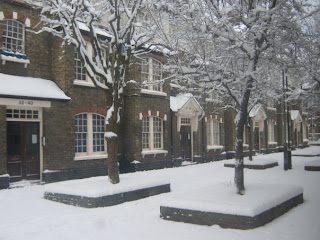
The weather isn't all bad here. No one believes that I don't mind the rain and cold, but I was used to rain living in Houston, and the cold is nothing compared to Ohio. It almost never snows in London, it's so mild--but, as it happens, I was lucky enough to experience one of the rare snows a couple weeks ago. Various reports claimed that it was the most snow London had seen for 20 years, or even for 40. It was a once a generation event, certainly. The first night we had a covering, all the twenty-something people in the neighborhood were out in the streets, making snowmen and throwing snowballs. The day following, Monday, saw a city that almost could not operate at all. Since snow is so rare, the city doesn't own many plows or salting equipment. None of the buses ran, few of the trains, and most of the workers couldn't make it in. I didn't even try.

The Dickensian view from my window:

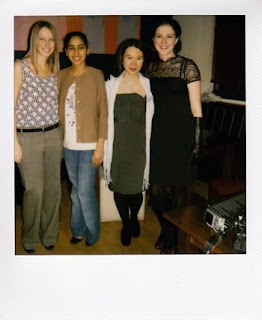
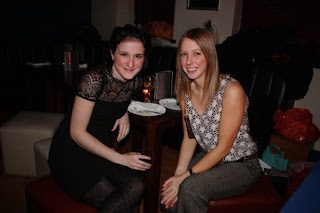
I'll end with a couple fun things I've done recently. A few weeks ago, a friend of mine had a 'fancy dress' birthday party. All we did was go to a bar for drinks, but to liven it up, she asked that we all dress like characters in a film noir movie. It seems like this 'fancy dress party' thing is popular here--although I've heard that it is considered an American thing, I think that must be because Halloween is so much bigger in the States. I seem to have tried harder than anyone else to fit the part--I had new long black gloves that were my grandmother's that I'd been looking for an excuse to wear, and enough spare time that afternoon to wonder whether YouTube had tutorials for 1940s hairstyles (it did).

More recently, Ollie invited me to come to a night of theatrical performances at a bar in Camden (yes, everything here seems to happen in a bar). It was mostly Cambridge graduates now in London and included one act plays, musicians, a dance piece, and, what I particularly wanted to see, the puppet play "Trouble" that Ollie wrote, directed, and acted in. Everything (or mostly everything--but I'm trying not to be critical) was enjoyable, but Ollie's play was the highlight. I was impressed by the amount of talent, but more by the evidence of so many artists putting much, much time into preparation. The little room above the bar was absolutely packed, far above the expected turn-out of about ten. This is the type of thing I love about London. I'm sure a similar scene could have occured almost anywhere in the world, but this city seems to attract artists and creative thinkers. I feel at home.

Monday, February 16, 2009

What happens in London

I have been saving up things to write about for quite a while and not having time to do it that I thought I would put them all up together and be done with it, but my entry got longer and longer, so I think I will need to break it up. For your reading pleasure, therefore, a montage of experiences of London:

I will start with the place where Londoners seem to spend most of their time: in a pub. I think pubs fill some of the function that a Starbucks might have in the States--but also, where Americans prefer meeting friends for a meal, it seems that Brits are more likely to invite someone just to have a drink (or tea). In any case, the people on my Shakespeare course got the idea that it would be fun to meet at a Shakespeare-themed pub. We did find one, one night, by accident, but since them we've been stumbling across them all over London. There are "Shakespeare's Head"s near Regent Street and Holborn, "The Shakespeare"s in Barbican and Victoria--there are even a few named after characters, like "The Falstaff" and "Othello".

The other most common London experience would probably have to be transport problems. I feel, first, that I ought to preface my horror stories by saying that I am always impressed by how well the public transport here works. Millions of Londoners don't even need cars because the tube, bus, taxi, and trains are so good.

But, with the amount of people who use the tube, problems are bound to happen. One day last term, I was trying to get from where I live, near Elephant and Castle in south London, to King's Cross in north London. I was on my way to a graduate conference at the British Library and had meant to be early so that I could stop by the university to run a few errands. I got on the train as planned, and was happily reading a copy of the London Review of Books when, at the next station, and for an unknown reason, there were so many people wanting to board the train that I thought there was no possibility they would all fit. Fit they did, and though I felt very much like a sardine, I supposed that many of the other passengers would change trains at the next station, Bank, which is one of the busier stations. But just before the train arrived at Bank, it was forced to stop in the middle of the tunnel. The lights flickered as the conductor turned the engine on and off. Everyone tried not to look at one another, not to talk. The heat was immense, and no one could take off their winter coats in the cramped conditions. We were left to sweat for twenty minutes before the conductor finally explained that someone had torn down some of the large paper ads that lined the tracks, and the paper needed to be cleared before the train could move. We were promised a quick arrival.

By this time the heat was so much that people were having trouble breathing. A girl standing behind me suddenly decided that she needed to get to the vent for some air and somehow managed to push and climb to the end of the car. A man in the middle chose to vent his feelings by cursing and yelling, and a boy near me, who must have been claustrophobic, began really to be sick. His poor father was trying hard to help him to breathe normally, but it was lucky a woman near them was able to pull out a plastic bag.

After a while the train was turned on, it lurched forward, and stopped. It rolled back. This was repeated for several minutes. On top of everything, the train was broken. As I remember, we were stuck for nearly forty minutes before we could be pulled into Bank, and I think everyone who had been on it must have felt as queasy as I did for the rest of the day.

That's my only gothic tale of transport problems--I promise. I think that day was probably the start of when I began to try to take the bus everywhere. And I'll leave off there, with the promise of pairing my tube story with a bus story soon.

Wednesday, January 21, 2009

Inauguration day in London

I have been awful about posting regularly--I suppose I should have thought that would happen at some point, with all the books I need to read for my master's program. I thought I would start again by telling how I spent yesterday, inauguration day, in London.

Oddly enough, Madame Tussaud's offered free admission to all Americans yesterday in honor of President Obama's inauguration--they were unveiling their new Obama wax figure. I went with Jen, a friend of mine from university. Normally, tickets are £25 per person. Does that seem like a fair price for a few rooms of wax figures, a tiny haunted house, and a short animated film about aliens obsessed with celebrities? One would think that with all the money they make from selling over-priced pictures, candy and souvenirs, the admission price at least could be under 10 pounds. I was glad to get in for free!

Some highlights:

Audrey and I have breakfast at Tiffany's.

One of my favorite Shakespearean actors.

Having a chat with Steven Spielberg.

Being spooky with Alfred Hitchcock.

Practicing my regal pose with Henry VIII.

Queen Elizabeth II and Prince Albert.

The Bard himself, back from the dead.

Speaking of back from the dead...

And, finally, the man of the hour himself.

After all this excitement, I went home and sat in bed to watch the inauguration over the internet. But yesterday wasn't just inauguration day, it was also a friend's birthday, so as soon as the ceremonies were over and I had watched George W. officially leave Washington, I left too, to head to Covent Garden. We went to a restaurant called Belgo, a Belgian restaurant and bar. It was down in a basement, and the waiters were all dressed like monks. I tried both Belgian beer (raspberry beer? who knew?) and mussels for the first time (so good) and, of course, had a waffle for dessert. What a night.

A picture of the inside of Belgo. The man in the middle wearing all black is one of the waiters, dressed as a monk.

Tuesday, November 18, 2008

Trip to Oxford with some fellow Shakespeareans

On Saturday, some girls in my Shakespeare course convinced me to travel to Oxford with them for the day. Even though more than one of us was worried about finishing essays on time for this week, I think we enjoyed ourselves...

We ate lunch at a pie restaurant in a covered market in Oxford. I think it will be my goal for the rest of my time here to learn how to make these: in case you can't tell in the picture, that's mashed potatoes with a meat pie on top (mine was cider pork and apple, yum) and minted smashed peas on top of the pie, all drenched in gravy. True British fare. From left to right: Jen, Ashley, Amanda.

This is the largest room in Blackwell, supposed to be the largest bookstore anywhere. Three miles of bookshelves. Three miles! I bought a Shakespeare magazine.

Somewhere near the Bodleian library, Oxford University's famous and ancient copyright library.


A close-up of one of the heads.

The Divinity School, where our tour of the Bodleian started. We weren't allowed to take pictures in the rest, which was a shame.

The outside of the old part of the Bodleian.

St. Mary's church, just opposite the Bodleian.

Me outside the Eagle and Child pub, where the Inklings (including C. S. Lewis and J. R. R. Tolkien) used to meet every Tuesday morning for over twenty years (from 1939-62) to drink beer and read and discuss the books each were currently writing. They referred to the pub as the Bird and Baby.

The 'Rabbit Room' inside where the Inklings would sit every week. You can see a picture of Lewis on the far right.

Me and Jen in the Rabbit Room with our mulled cider. Worth going back to Oxford for.

Sunday, November 9, 2008

Remembrance Sunday in the UK

Today was Remembrance Sunday in the UK, a celebration that goes along with Remembrance Day on Tuesday (Veteran's Day in the US). I've been struck, the past few weeks, by the difference in attitude toward this national holiday here as compared to America.

I started seeing people wearing red paper poppies a few weeks ago and at first couldn't figure out why. In the States, it seemed like we might buy a poppy at a supermarket to support a veteran's group, but no one would wear them around. Here, you see them everywhere: a constant reminder of both the World Wars and the wars happening now. It's almost required that you wear one: I was told that if TV personae don't have them on by the week leading up to Remembrance Day, their station will get hundreds of angry phone calls. The celebration on Remembrance Sunday is also a big deal: there is a parade in Whitehall, with the Royal Family and members of all the Armed Forces coming to lay wreaths at The Cenotaph, a stone tomb erected after WW1 in memory of those soldiers whose remains are elsewhere.

It does make sense that people in the UK would be more conscious of the effects of war: London was completely destroyed by bombs in The Blitz during WW2, as was much of the rest of the country. Compared to that, regular US citizens didn't see much during the war. It's become a part of the public consciousness over here in a way I'm only beginning to fathom.

In America, I've heard it said that there is a public forgetfulness over what has happened in our past--that's why 9/11 was widely termed a "wakeup call." But I think it goes further than that. We aren't even very aware of the war we're in now. On Sundays, George Stephanopoulos on his show This Week lists American soldiers who have died in Iraq that week. But the media are not allowed to cover the repatriation ceremonies of soldiers' bodies, a policy that George W. Bush created so that Americans' sensibilities wouldn't be upset--or to prevent too large of a public outcry against the war, depending on how you look at it. In the UK, live coverage of every repatriation ceremony is shown on multiple television networks. The bodies are given full military honors, with attendance often including bands, high-ranking government officials, and members of the royal family. Citizens line the streets to see the coffins pass, holding minutes of silence in respect.

If I could ask one small favor of the president-elect, it would do would be to change Bush's policy. Men and woman who are willing to fight and to die for our country ought to be afforded every honor possible in gratitude for their service and sacrifice. It's the least they deserve.

Sunday, October 19, 2008

Shakespeare tours London with a boy from Wales

An old friend (and ex-coworker) of mine--Robby, an Atlanta native now earning an IB in Wales--came to spend the weekend with me. We spent his first day here doing a walking tour of London.

Shakespeare at platform 9 3/4 in King's Cross train station.

Shakespeare at the British Library. It used to be part of the collection of the British Museum: to use the books, you would get to sit in the beautiful Reading Room in the middle of the museum. While the reading rooms in the new location (which opened in 1997) are still very comfortable and impressive, I don't think the Chinese feel of the exterior matches what the library stands for.

Shakespeare with Jeremy Bentham, the eighteenth century political philosopher who left his body to University College London to be displayed inside the university.

Robby outside the Royal Courts of Justice on the Strand, looking worried.

Shakespeare outside the Royal Courts of Justice, looking considerably more poised than Robby. (The hand is Robby's: don't worry, I didn't break any of my fingers.)

Thursday, October 16, 2008

Catch-22s for Immigrants

I am frustrated this morning. It's easy not to think about this in today's world of the online global community, but effectively, when you move to a new country, you become almost a non-person. No contacts, no renting history, no credit history. You don't exist until you start paying utility or credit card bills.

One would think that it ought to be easy for someone with a legitimate reason (say, a student) to move to another country. But if often seems that things have been designed to throw obstacles in an immigrant's way.

Your experience as an immigrant to the UK might be something like this: you cannot get a visa without first having a job. But you are unlikely to get hired without a visa. Even if (like me) you have been accepted to a UK university, your visa application might still be rejected. The universities don't seem to have any power to tell the immigration office who to admit to the country.

Once you make it here, of course, you will need somewhere to live. But you may find this hard as well: most likely, without a renting history, you will be required to provide a guarantor who must be a land-owning UK citizen. Arrived in the country with no contacts? You might be out of luck. If you have a guarantor, or if you don't need one, you will still need a UK bank account. Problem there? You're often required to have lived in the UK for 12 months before you can open a bank account, and you will need first to have a permanent address (which you don't have yet, remember, because you're looking...)

And then, perhaps, after you're settled, and you wait until you have a bank statement or utility bill and a debit card so that you can finally get yourself a mobile phone with a monthly plan (by far the most cost-effective option). So you take your documents and go to the phone store, only to be denied on a credit check (yes, they check your credit to sell you a phone).

Such was my luck today. I wasn't trying to buy a house or a car, just a phone, but because I've only been in the country for a little over a month, I have no credit history. Now, worst of all, since I've been denied a mobile phone, I'm starting out with bad credit history.

I'm trying not to sound bitter. I understand, of course, why it is that I am almost a non-person in the UK at this moment, and why in many cases it must be that way, although I have to wonder if there's a reason why a credit check company can't exist across national borders. But really--should my lack of credit history prevent me from buying such a small item as a mobile phone? And should the fact that I tried to get a phone soon after I moved here because I need phone hurt my credit score?

I was a bit bewildered while applying for my Visa when I had to travel into downtown Houston to have my fingerprints taken. My father thinks this is because George W. started a policy that all immigrants to the U.S. must have their fingerprints taken, and so other countries created that policy for Americans as retribution. That was bizarre, but I think this beats it. In the United States, someone who walked into a phone store with a bank statement to prove their ability to pay--who would even be willing to pay a few months worth of statements ahead of time--would have no problem getting a phone. They might beg her to do so.

I'm hoping this will be the end of the seeming catch-22s I encounter, but I fear that's wishful thinking. I've never had to worry about my credit history before, but apparently now I will need to consciously build it up.

Saturday, October 11, 2008

More Adventures of Lego Shakespeare

My church met in a different location a couple weeks ago and I had the misfortune of encountering a bus fare machine that didn't work, so I ended up walking all the way from Bloomsbury to Victoria. On the way there, I found myself passing Buckingham Palace through the middle of a bicycle race, but it seemed like a good opportunity to get a picture of Shakespeare at the Palace.

One day I walked from Victoria over to the South Bank Centre to meet someone. As Shakespeare and I were going over the bridge, we decided to stop and admire the view of the houses of Parliament and the London Eye.

I went to see Timon of Athens at the Globe last week with my flatmate and her boyfriend. Unfortunately, it was too dark to get a good picture, and Shakespeare's head also had come off in my purse. I bought some super glue, so in future pictures, Shakespeare won't be headless.

Friday, October 10, 2008

Puppets and libraries

If life can settle down in London, it appears finally to be doing so: I have moved into my flat, purchased necessary furniture, set up an internet connection, started school. Now a routine can start to form, which doesn't mean that days can't exist (like today) that seem so out of the ordinary to be a little surreal.

My daily schedule has generally been starting rather early, with toast and jam for breakfast with a cup of tea. I discovered a wonderful magazine called the London Review of Books which makes great reading over breakfast or on the tube, so I generally carry that around with me. I have class two days a week, though I am generally in the area of London where UCL is more days than not: the course convenor for my MA told us that the British Library should become "like a second home," and I have a feeling those words were more prophetic than advisory; so most mornings I think I'll be leaving pretty early if not to go to class than to set up in one library or another for a day of reading and writing.

This morning, that was my plan. I woke up early and was making my second cup of tea when my flatmate Becky's boyfriend, Ollie, popped in and announced that he had free tickets to a show at the Little Angel Puppet Theatre to see Sleeping Beauty. Of course I can't turn down a chance to see a puppet show, so at 10am I found myself in Angel, which turned out to be a charming area with lots of antique shops and patisseries, in a tiny theatre behind a garden with a tiny stage for tiny puppets. Most of the audience were under five years old except for a sprinkling of mothers and the little group of postgraduates sitting in the back that Ollie convinced to come. But all of us really enjoyed it: there's something really charming about puppets.

After lunch I said goodbye to Becky and Ollie and headed over to the British Library. I had reserved a copy of a play published in 1728 to read in the Rare Books Room. The BL is a copyright library, so they have--literally--everything. But you cannot check anything out: if you have a Reader's Pass, you can order books to read inside the library. There is a somewhat elaborate process to be allowed to read a book. You must leave all of your belongings except what is allowed in the reading rooms (pencils, paper, laptops on silent, etc.) in the cloakroom. Everything that you take with you must be placed in a clear plastic bag. At the entrance to the reading room you must flash your Reader's Pass and then proceed to an empty seat. Noting your seat number, you may either proceed to a computer to order reading material (which may take 70 minutes to arrive) or, if you were smart enough to order it online ahead of time, to an issue desk to retrieve your book. You then sit with it at your desk until you are done, at which point you may return it to the issue desk and request that they keep it for you for three days. On exiting, your clear plastic bag is inspected for stowaways.

Despite all this, it's an amazing experience to visit the BL. Once you make it through their security measures, they are remarkably lenient about what you can be allowed to read. I almost couldn't believe that they would just hand me a copy of a rare play from 1728 this afternoon, but they did. I sat in the middle of the reading room in a comfortable leather chair and alternated between taking notes on the text I was reading and enjoying watching the people around me. People watching is rapidly becoming one of my favorite activities to do in London, and the British Library seems to be a great place to do it if you're interested in older scholarly (and sometimes slightly eccentric-looking) types.

The play I was looking at is called The Double Falshood, or Lovers Distressed by Lewis Theobald, though Theobald claims that he only edited it and that the text is actually the lost play Cardenio by Shakespeare. Reading it, I find it hard to believe that it could actually have a Shakespeare manuscript behind it. It was entertaining, and certainly accomplished and polished poetry, but there wasn't anything special about the language itself.

I ended the day with more puppets: Ollie shares my love of the Muppets and so we all watched some episodes of The Muppet Show together. A good end to a satisfying day, really.

Monday, September 15, 2008

Shakespeare in Bloomsbury

Shakespeare and I are living in Bloomsbury for the next week, between UCL and the British Library. It's probably the most literary area of London (think Virginia Woolf and the Bloomsbury group), and we love it here.

Friday, September 12, 2008

Y-M-C-A

In case anyone is curious about what living at a YMCA is like, I thought I'd post some pictures of the room I'm in.

Lo and behold: right across the street is The Shakespeare pub. I might have to check it out.

While I was unpacking, I found my Shakespeare posable figure in my purse and thought it would be fun to take a picture of Shakespeare at the YMCA.


And of course, I had to have a picture of Shakespeare outside of his namesake. My camera couldn't keep both in focus--I tried several times and attracted quite a few quizzical stares for holding a small plastic toy up in the air.

Flats update and what bedsits are

It seems strange to think that yesterday I spent most of the day complacently writing and reading, thinking that by the end of the day, I would either have a bedsit room or have made an offer on a flat. Neither happened, but I think it's for the best.

Last night and this morning were frantic, between deciding not to take a two-bed flat we had been close to wanting, adding a third flatmate, and suddenly finding that the hostel I planned to stay in this week didn't have any rooms available. I have a place to stay now until the 22nd--I had to book a room in the YMCA for three days until I can move into a little hotel in Bloomsbury, but it isn't as bad as I expected. As for the flats, we are, so to speak, back to square one, but I have a feeling the looking and deciding will go faster this time.

I did like both the bedsits I saw over the past few days, but I would much rather live have flatmates, so there are people around to talk to! The first I saw was an elderly lady renting out a spare bedroom in her house. She lived there with her daughter, son-in-law and grandson. The room was spacious and nice, but no washing machine, no dishwasher, no oven, and no going out at night. She gave me tea and cookies and we had a nice chat, but it didn't take too long to decide I would pass. The second was a middle-aged woman renting out a room in her house. She lives there by herself as her son is getting his MA somewhere up north. It was much smaller, but had a very large desk and full use of the house. She knew quite a bit about literature and so we had a chat about my thesis topic over tea. The area she lives in is called the Shakespeare Collective, apparently--the street names are after characters from the plays: Cressida, Miranda, Prospero, and I think I saw Lysander. I love how London is so full of literary history than even streets get named after famous literature. I walked out of the YMCA tonight and saw, just across the street, a pub called The Shakespeare. I love it.

Coming soon: Lego Shakespeare Tours London

Wednesday, September 10, 2008

To bedsit or not to bedsit

In London, there is an option for those seeking affordable (read: cheap) accommodation that, I believe, is unheard of in the U.S. It's called a bedsit: and I think that it's either something close to what we Americans call an efficiency, or it's a room in someone's house that they are renting out.

Since I'm not sure whether or not I'll have to live by myself, I've made a couple appointments to look at some bedsits in Camden. Both were listed on the University of London's housing database, so I think the landlords must have been checked out by the university and I'm reasonably confident that they will turn out to be nice. Both landlords are women, and they sounded on the phone like nice, motherly ladies.

I'd much rather have a flatmate, if only just so that I would have someone to talk to, but I have to admit that there's something romantic about the idea of renting a room from one of these women. I keep imagining that it will be like in Little Women when Jo goes to New York and rents a room in the attic of Mrs. Kirke's boarding house. (I think one of the rooms I'm looking at actually is in the attic of the house.)

Of course, I don't know yet whether my imagination will turn out to be like the truth. It could be a disaster: small room, mean landlord, no one to talk to. Plus, in some of them, I'd have to share a bathroom with another tenant.

My goal was to know where I would be living by today. If I end up living south of the Thames with a flatmate, then that might happen. If I end up needing to find a place by myself, I probably won't know until at least later in the week. So the "battle" keeps going.

Tuesday, September 9, 2008

Finding a flatmate (and a flat)

I'm in the middle of the "battle" (as my dad calls it) to find a place to live. It's difficult since I don't know many people here. To find a flatmate, for example, I had to rely upon the university's housing message boards.

I tried to find a flatmate before I left, so that even though I would be arriving in London without a place to live, I'd at least have someone to live with. That didn't quite work out: I am meeting a girl tomorrow who I might live with, but she's also looking at single rooms, which means I have to as well.

These online message boards are a lot like internet dating. I've never had to do this before: either the university assigned me to someone else or I got together with a couple friends. It's a weird experience to advertise myself online and then to field responses. You can post an advertisement of your own ("I'm 21, from Texas, and starting a master's degree in Shakespeare. I don't smoke and am quite tidy.") or respond to others. Sometimes it's a landlord making a post. There seem to be quite a few ladies who live in Camden who are looking for postgraduate students to live in a room in their house, so I've been calling some of them.

I couldn't look much over the weekend, so I've been really looking now for two days. I'm already sick of it! I don't like looking all by myself and trying to coordinate with landlords and letting agents and walking all over London and (as happened last night) sometimes getting lost. But I suppose if I can do this, I can do anything.

I think it's a bit harder for me since I'm just moving to the country, and so I don't have a renting history in the UK. Landlords are less likely to want to rent to me. This whole process--getting a visa, finding a place to live, finding a job--seems designed to keep Americans out of the country. You'd think they would give some of us a chance!